

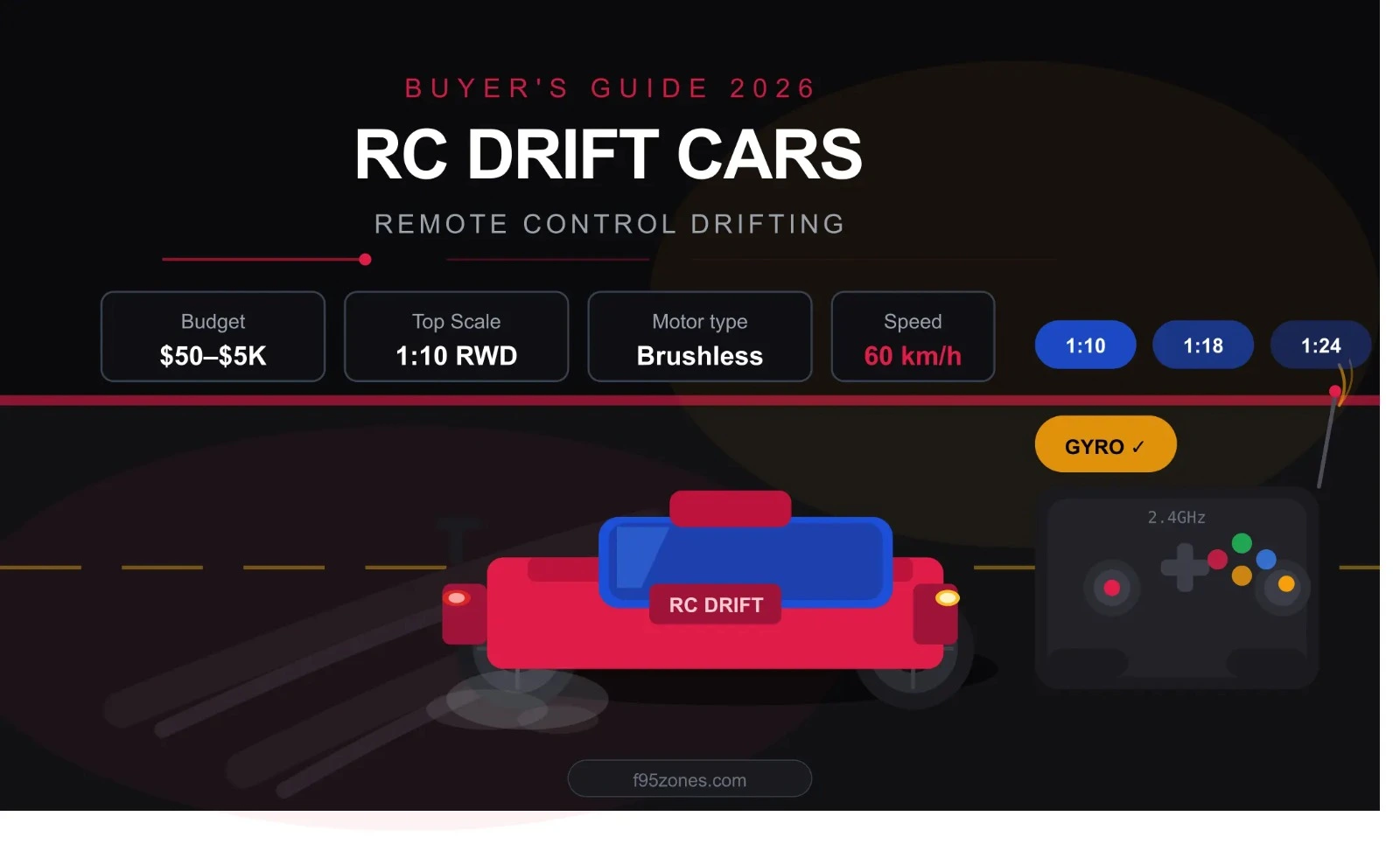
What Are Remote Control Drift Cars?
Remote control drift cars — also called RC drift cars — are precision-engineered miniature vehicles designed specifically for executing controlled sideways slides. Unlike standard RC racing cars optimized for grip and straight-line speed, drift cars use specialized low-traction tires, rear-wheel-drive setups, and fine-tuned suspension geometry to achieve the same spectacular drifting maneuvers you’d see at a professional motorsport event — scaled down to fit your living room, backyard, or local track.
The RC drift scene has exploded in recent years, with manufacturers developing increasingly sophisticated gyro systems, brushless motors, and adjustable suspension setups that make controlled sliding more accessible than ever — whether you’re 8 or 48, whether your budget is $50 or $5,000.
Internal Link: Love gaming and tech? Explore our Games section on F95zones for racing simulators and more you can play for free right now.
RTR vs Kit – The First Decision Every Buyer Must Make

Before choosing a specific car, you need to decide between two fundamental approaches:
H3: Ready-to-Run (RTR) Models
RTR cars come pre-assembled with all electronics included. You charge the battery, bind the controller, and you’re drifting within minutes of opening the box.
Best for:
- Complete beginners with no RC experience
- Players with a budget of $50–$400
- Those who want to try the hobby before committing to a full kit build
- Children and casual hobbyists
Limitations:
- Entry-level electronics that you’ll eventually replace
- Less tuning flexibility
- Lower performance ceiling
H3: Kit Builds
A kit gives you the chassis and mechanical components; you purchase the electronics (motor, ESC, servo, gyro, radio) separately.
Best for:
- Serious enthusiasts committed to long-term improvement
- Players who want to learn how RC cars work mechanically
- Those with budgets of $400+
- Anyone wanting maximum customization and upgrade paths
The honest truth: If you’re a serious drifter, kit is almost always the better long-term investment. The electronics in most RTR packages are entry-level and will be replaced within months of active use.

RC Drift Car Scale Guide – Which Size Is Right for You?
Scale determines how your car feels, where you can use it, and how detailed and fast it is. Here’s the complete breakdown:
| Scale | Best Environment | Description |
| 1:43 | Indoor, desk, small rooms | Micro drift machines; palm-sized; great for tight indoor spaces; many include gyros and LED lights |
| 1:24 | Indoor, beginner-friendly | Compact and manageable for first-time players; easy to store |
| 1:18 | Indoor or outdoor | Versatile mid-range; popular with families and casual players |
| 1:16 | Indoor and outdoor | Balance of power and control; works across most environments |
| 1:10 | Outdoor, club tracks | The gold standard for serious drifters; maximum customization and aftermarket support |
The 1:10 scale is what you’ll find at competitive RC drift events. The 1:43 and 1:24 scales are fantastic for indoor fun and beginners learning the basics of throttle and steering control before scaling up.
Essential Components of an RC Drift Car
Understanding the components helps you make smarter buying decisions and upgrades. Here’s what’s inside every drift car:
H3: Motor
- Brushed Motor: Entry-level, affordable, less efficient, slower. Found in most RTR beginner models. Good starting point.
- Brushless Motor: More powerful, efficient, and durable. Standard in intermediate and advanced builds. Worth upgrading to as soon as budget allows.
H3: ESC (Electronic Speed Controller)
The brain of your drivetrain — controls how power flows from battery to motor. Quality ESCs allow fine-tuning of throttle curve, braking force, and reverse sensitivity. Critical for smooth drift initiation and recovery.
H3: Servo
Controls your steering. Drift cars benefit from high-speed servos with significant steering angle — more angle means tighter, more aggressive drift arcs. Look for metal-gear servos for durability.
H3: Gyro
The gyroscope is what separates a dedicated drift car from a converted touring car. The gyro automatically corrects oversteer, helping the front wheels track correctly during sustained slides.
- Beginner setting (high sensitivity): Gyro does most of the correction work — stable, easy control
- Advanced setting (low sensitivity): More natural, challenging driving — you provide most of the counter-steer input
H3: Radio System (Transmitter & Receiver)
- Modern systems use 2.4GHz frequency — zero interference with other RC cars nearby, enabling multi-car drift sessions
- Look for proportional control (not on/off) for smooth throttle and steering inputs
- Avoid older 27MHz systems — they cause signal interference and are outdated technology
H3: Drivetrain – RWD vs AWD
| Drivetrain | Performance | Difficulty | Recommendation |
| RWD (Rear-Wheel Drive) | Realistic drift dynamics, adjustable | Higher learning curve | Recommended for serious drifters |
| AWD (All-Wheel Drive) | Easier to control, forgiving | Lower learning curve | Acceptable for beginners, but not true drift |
The RC drift community has overwhelmingly moved toward RWD in recent years. AWD models are easier to drift but are not what you’ll see at competitive events or serious club sessions.
Best Remote Control Drift Cars by Category (2026)
H3: Best Budget RC Drift Car (Under $100)
Look for 1:18 or 1:24 scale RTR models with gyro systems included. At this price point, prioritize:
- Built-in gyro for stability assistance
- 2.4GHz controller (not 27MHz)
- Rechargeable LiPo or NiMH battery included
- Spare tire set included (drift tires wear quickly)
- Speeds of 20–30 km/h are appropriate at this scale
What to expect: Excellent fun for beginners and younger players. Not competitive-level hardware, but genuine drifting is absolutely achievable.
H3: Best Mid-Range RC Drift Car ($100–$400)
Top recommended models in this bracket:
- Redcat Racing EPX Drift (1:10 RTR): Carbon fiber chassis, brushless motor, fully adjustable suspension. One of the best RTR-to-track-ready platforms available.
- HPI Sport 3 Drift Series (1:10 RTR): Available in iconic liveries including James Deane Nissan S15, Vaughn Gittin Jr. Ford Mustang, and Dai Yoshihara Subaru BRZ. Great balance of fun and performance.
- Yokomo YD-2Z (1:10 RTR): Purpose-built RWD drift chassis, massive steering angle, tons of aftermarket support. Our top beginner recommendation for anyone serious about the hobby.
H3: Best Advanced / Kit-Build RC Drift Car ($400+)
- MST RMX 2.5 Kit: The benchmark kit for learning drift fundamentals. Predictable handling, adjustable suspension geometry, and realistic weight distribution. Widely regarded as the top choice for hobbyists serious about skill development.
- MST RMX 2.5 S: The performance step-up from the standard RMX, for drivers ready to fine-tune for competitive events.
- Yokomo YD-2Z Plus: Upgraded version of the YD-2Z with enhanced chassis rigidity and steering precision.
What to Look for When Buying – Full Checklist
Before clicking “add to cart,” verify these factors:
Build Quality Indicators:
- Ball bearings (not bushings) in the drivetrain
- Aluminum shock caps and chassis bracing
- Reinforced suspension arms
- Metal-gear steering servo
Electronics Checklist:
- 2.4GHz radio system (proportional, not on/off)
- Brushless motor for anything above beginner level
- Gyro included or compatible mount available
- LiPo-compatible ESC (higher performance than NiMH)
Aftermarket Support:
- Spare parts availability from the manufacturer
- Active community and modding ecosystem
- Body shell options (standard 1:10 bodies fit most 1:10 kit chassis)
Surface Compatibility:
- Low ground clearance → smooth indoor surfaces only
- Higher clearance → outdoor parking lots and paved surfaces
- RC drift cars are not for grass, gravel, or rough terrain
How to Set Up Your RC Drift Car for Maximum Performance
Once your car arrives, these setup steps dramatically improve the out-of-box experience:
Step 1: Break In the Motor
Run the motor under light load for the first 10 minutes. Avoid full-throttle bursts during break-in — this extends motor life significantly.
Step 2: Set Gyro Sensitivity
Start at 70–80% sensitivity for your first sessions. As your car control improves, reduce sensitivity in 10% increments until you’re comfortable at 30–40%.
Step 3: Adjust Camber
Slight negative camber (tops of tires leaning inward) improves drift stability. Most kit cars allow camber adjustment via turnbuckle links. Start at -1.5° and adjust based on tire wear patterns.
Step 4: Choose the Right Surface
The best indoor drift surfaces are:
- Polished concrete
- Smooth tile
- Hard wood floors
- Vinyl flooring
Avoid carpet — even low-pile carpet kills slide initiation for most RC drift setups.
Step 5: Install Drift Tires
Drift tires are hard-compound polished plastic or semi-hard rubber designed to slip. Never use soft rubber grip tires for drifting — the car will snap back unpredictably.
How to Learn to Drift Your RC Car – Beginner Technique Guide
Learning to drift well takes practice, but these fundamentals will get you sideways faster:
The Clutch Kick (Throttle Punch)
- Apply light throttle through a corner entry
- Briefly punch full throttle to break rear traction
- Immediately counter-steer (steer opposite to the slide direction)
- Modulate throttle to maintain the slide angle
The Feint / Scandinavian Flick
- Steer sharply in the opposite direction of your intended drift
- Immediately snap back to initiate the slide with momentum
- Most effective on smooth surfaces with RWD cars
Throttle Discipline
The most common beginner mistake: too much throttle. RC drift is about finding the exact throttle percentage that maintains a slide without spinning out. 40–60% throttle is where most slides live for beginner to intermediate setups.
Remote Control Drift Cars vs Regular RC Cars – Key Differences
| Feature | RC Drift Car | Regular RC Racing Car |
| Tire compound | Hard/plastic (low grip) | Soft rubber (high grip) |
| Drivetrain | RWD optimized | AWD or 4WD |
| Suspension | Tuned for slide recovery | Tuned for cornering grip |
| Speed focus | Control and angle | Maximum velocity |
| Surface | Smooth hard floors | Track, carpet, outdoor |
| Gyro system | Usually included or recommended | Rarely included |
RC Drift Community – Where to Connect
Getting involved with the RC drift community dramatically accelerates your learning and helps you find local drift events:
- RCMF (RC Model Forum) — One of the largest RC communities worldwide with dedicated drift sections
- Drifted.com RC Drift Section — Expert reviews, setup guides, and model comparisons from an authoritative motorsport site
- Super-G R/C Drift Arena — Premier resource for new drifters choosing between RTR and kit builds, with detailed electronics bundles
Frequently Asked Questions
What is the best RC drift car for beginners in 2026? For beginners on a budget, a 1:18 or 1:24 scale RTR with a gyro system provides the most forgiving experience. For those ready to invest in the hobby, the Yokomo YD-2Z is the top RTR choice, while the MST RMX 2.5 Kit is the gold standard for kit builders.
Can you drift an RC car on carpet? Standard RC drift tires are designed for hard smooth surfaces. Carpet creates too much friction for most drift setups. Some players use slightly softer tires on low-pile carpet, but results are inconsistent.
What surface is best for RC drifting? Polished concrete, smooth tile, hardwood, and vinyl flooring provide the ideal slip resistance for RC drift tires. Outdoor smooth asphalt works well for larger 1:10 scale cars.
How fast do RC drift cars go? Budget models reach 20–30 km/h. Mid-range brushless setups hit 40–60 km/h. Advanced builds can exceed 60–80 km/h, though speed is secondary to control in drifting.
Are electric or nitro RC drift cars better? Electric (LiPo battery) cars are overwhelmingly preferred for drifting — they’re quieter, cleaner, more consistent in power delivery, and can be used indoors without fumes. Nitro engines offer realism but require significantly more maintenance and outdoor use.
How long does the battery last per session? Most LiPo-powered drift cars provide 15–30 minutes per charge. Investing in a second battery pack effectively doubles your run time with a quick swap.